Key Features
- Hexagonal modular smart lighting panels with individually addressable RGB LEDs
- Magnetic tool-free assembly with connecting clips for custom shapes
- iCUE software integration for dynamic lighting effects and sync
- Expandable ecosystem with additional LC100 expansion kits
- Compatible with iCUE ecosystem for syncing with other Corsair peripherals and fans
- Adhesive mounting for wall or case placement
Technical Specifications
Pros & Cons
Pros
- ✓ Extremely satisfying magnetic snap-together assembly
- ✓ Vivid, uniform color output across each panel
- ✓ Deep integration with iCUE for full RGB ecosystem sync
- ✓ Highly customizable layouts thanks to hexagonal design
- ✓ Expansion kits allow scaling to larger installations
Cons
- ✕ Requires iCUE software running, which can be resource-heavy
- ✕ Starter kit alone offers limited coverage area
- ✕ Higher price per panel compared to basic LED strips
- ✕ Cable routing between panels can get messy in large layouts
- ✕ No standalone controller for non-iCUE users
In-Depth Review
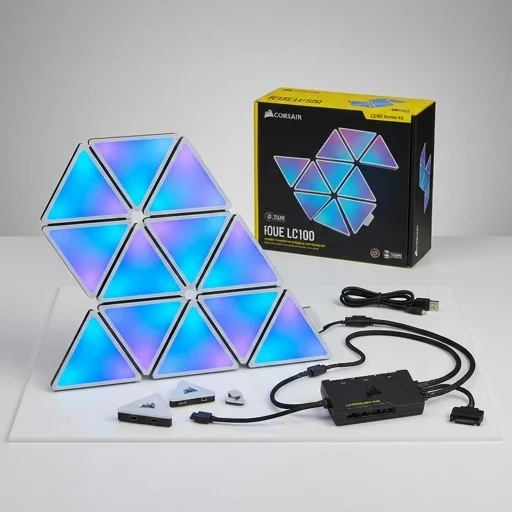
The Corsair iCUE LC100 Smart Lighting Panels bring a striking architectural dimension to PC lighting setups, moving beyond simple strips and fans to offer modular, geometric panels that can be arranged into countless configurations behind a monitor, across a wall, or along a desk. Each triangular panel features individually addressable RGB zones capable of producing smooth gradients, sharp color breaks, and fluid animations that ripple across connected panels as a unified canvas rather than isolated light sources. The panels connect magnetically and link via a proprietary cabling system, allowing builders to snap together honeycomb-like clusters, staggered rows, or asymmetric bursts of light that transform a plain wall behind a battlestation into a dynamic visual centerpiece. What sets the LC100 apart in the ambient lighting space is its integration with Corsair's iCUE software ecosystem, which allows the panels to sync in real time with other iCUE-compatible components like keyboards, mice, coolers, and case fans. Users can create custom scenes where the panels react to on-screen action, music, or system temperatures, turning the lighting into a functional feedback layer rather than mere decoration. The software also supports precise per-panel control, letting users assign different colors or effects to individual triangles within a larger mosaic, and the ability to save multiple profiles means the same physical layout can shift instantly from a calm ambient wash for late-night sessions to an aggressive strobing pattern during gameplay. Physically, the panels are built with a matte diffusion layer that softens the LEDs into an even glow rather than harsh pinpoints of light, which matters greatly in ambient applications where the goal is atmosphere rather than direct illumination. The mounting system includes adhesive strips and connector clips designed for renter-friendly, damage-minimal installation, while the modular nature means the array can be expanded incrementally as budget allows, starting with a small cluster and growing into a full wall installation over time. For anyone building out a cohesive RGB ecosystem around their desk or gaming corner, the LC100 panels serve as a flexible, expressive backdrop that ties together the ambient lighting layer with the rest of a Corsair-equipped rig, delivering both visual impact and the kind of granular customization that ambient lighting enthusiasts specifically seek out.
What Buyers Say
Snapped together in minutes and syncing with my Corsair keyboard and fans looks incredible. The hex shapes let me build a custom logo pattern on my wall.
The starter kit is a bit sparse for a real wall design. Had to buy an expansion pack to get the look I wanted, but the quality and colors are excellent.
Love the effects and brightness, but iCUE has to be running constantly which uses more RAM than I'd like. Otherwise a great lighting upgrade.
These panels transformed my streaming setup. The magnetic connections feel premium and effects transition smoothly across all panels.
Works well and looks sleek, but the cost per panel adds up fast if you want full wall coverage. Still, the build quality justifies part of that price.